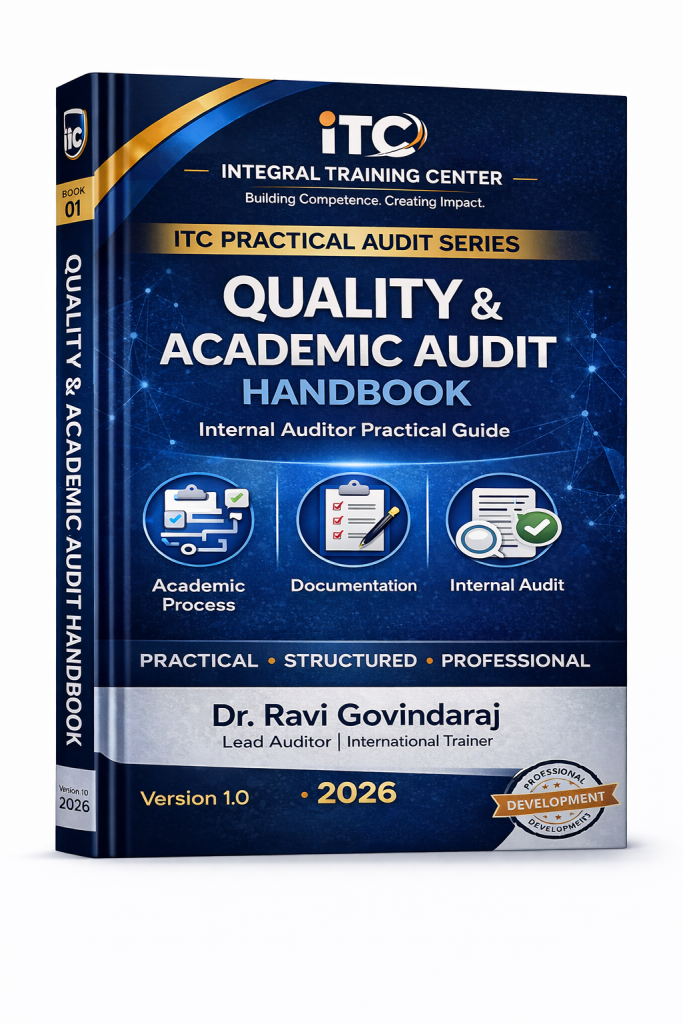


A practical guide designed to help educational institutions build strong academic systems through structured audit practices. This handbook simplifies complex quality concepts into clear, actionable steps that improve teaching-learning effectiveness, documentation control, and institutional performance.
It provides practical tools for internal auditors, IQAC teams, and academic leaders to establish evidence-based processes that support continuous improvement and accreditation readiness.
Ideal for colleges seeking systematic quality enhancement and sustainable academic excellence.
Key focus areas
Academic process • Documentation • Internal audit • KPI monitoring • Continuous improvement
Quality & Academic Audit Handbook
ITC Practical Audit Series
This handbook is a step-by-step practical guide for colleges, universities, and higher education institutions to establish a strong quality culture through structured academic audit systems.
Unlike theoretical books, this guide focuses on real implementation, helping institutions align teaching, learning, documentation, and academic governance with quality standards, accreditation expectations, and measurable performance indicators.
It acts as a ready reference manual for:
- IQAC Teams
- Internal Academic Auditors
- Principals & Academic Directors
- Department Heads (HODs)
- Accreditation Committees
- Quality Coordinators
- University Affiliated Colleges
- Autonomous Institutions
The handbook converts complex quality frameworks into simple, usable tools that ensure consistency, transparency, and continuous improvement in academic delivery.
WHY THIS BOOK IS IMPORTANT FOR COLLEGES 🎯
Many colleges struggle with:
- Lack of structured academic documentation
- Last-minute preparation for accreditation
- Inconsistent teaching quality
- Weak evidence for NAAC/NBA audit
- Poor KPI tracking
- Non-standardized processes
- Missing academic improvement cycle
- Audit fear due to lack of clarity
This handbook eliminates confusion by providing:
✔ Ready audit formats
✔ Department evaluation methods
✔ IQAC operational structure
✔ Evidence checklist system
✔ Academic KPI tracking tools
✔ Continuous improvement cycle model
✔ Risk identification framework
✔ Corrective action methods
HOW THIS BOOK BENEFITS COLLEGES 🏫
1. Improves Academic Quality
Helps institutions standardize lesson planning, syllabus delivery, assessment systems, and feedback mechanisms.
2. Strengthens IQAC Function
Provides structured formats for Internal Quality Assurance Cell to monitor academic performance effectively.
3. Makes Accreditation Easier
Aligns institutional processes with NAAC / NBA / ISO expectations, reducing last-minute stress.
4. Enhances Teaching Effectiveness
Ensures measurable learning outcomes and systematic academic monitoring.
5. Ensures Documentation Readiness
Provides templates and evidence collection guidelines for academic compliance.
6. Creates Continuous Improvement Culture
Promotes regular review, corrective actions, and performance tracking.
7. Builds Institutional Credibility
Supports ranking, recognition, and stakeholder confidence.
UNIQUE FEATURES OF THIS HANDBOOK ⭐
- Practical implementation approach
- Ready-to-use audit checklists
- Academic KPI monitoring formats
- Evidence-based evaluation method
- Continuous improvement cycle tools
- Department performance review model
- IQAC strengthening strategies
- Easy-to-follow structure
- Suitable for all streams (Arts, Science, Engineering, Management)
- Useful for both new and experienced auditors
DETAILED INDEX (TABLE OF CONTENTS)
SECTION 1 – INTRODUCTION TO ACADEMIC QUALITY
Chapter 1 – Understanding Quality in Higher Education
- Meaning of academic quality
- Quality culture in institutions
- Importance of structured academic systems
- Role of leadership in quality
Chapter 2 – Fundamentals of Academic Audit
- What is academic audit
- Difference between inspection and audit
- Types of academic audits
- Internal vs external audit
Chapter 3 – Role of IQAC in Academic Excellence
- IQAC structure
- Responsibilities of IQAC team
- Academic monitoring role
- Quality benchmarks
SECTION 2 – ACADEMIC PROCESS STANDARDIZATION
Chapter 4 – Curriculum Planning and Delivery
- Academic calendar preparation
- Syllabus planning structure
- Lesson plan framework
- Teaching schedule monitoring
Chapter 5 – Teaching Learning Process Control
- Teaching methodologies
- Outcome based education approach
- Student engagement strategies
- Teaching effectiveness indicators
Chapter 6 – Student Assessment Systems
- Internal assessment framework
- Examination planning
- Evaluation transparency
- Result analysis methods
SECTION 3 – DOCUMENTATION SYSTEM
Chapter 7 – Academic Documentation Framework
- Types of academic records
- Department documentation structure
- Faculty academic file system
Chapter 8 – Record Control and Maintenance
- Version control methods
- Document approval system
- Retention period guidelines
Chapter 9 – Evidence Collection for Audit
- Academic evidence types
- Digital documentation practices
- File naming standards
SECTION 4 – INTERNAL ACADEMIC AUDIT SYSTEM
Chapter 10 – Planning Internal Academic Audit
- Audit planning process
- Department audit schedule
- Auditor selection criteria
Chapter 11 – Academic Audit Checklist Preparation
- Checklist development method
- Evidence based questions
- Risk identification areas
Chapter 12 – Conducting Academic Audit
- Audit interview techniques
- Classroom observation method
- Documentation verification process
Chapter 13 – Non-Conformity Identification
- Types of academic gaps
- Major vs minor non-conformities
- Observation recording method
SECTION 5 – KPI MONITORING & PERFORMANCE REVIEW
Chapter 14 – Academic Key Performance Indicators
- Teaching KPI examples
- Student performance indicators
- Department performance metrics
Chapter 15 – Result Analysis System
- Pass percentage analysis
- Subject performance review
- Improvement planning
Chapter 16 – Faculty Performance Review
- Teaching evaluation format
- Feedback system structure
- Performance improvement planning
SECTION 6 – CONTINUOUS IMPROVEMENT FRAMEWORK
Chapter 17 – Corrective and Preventive Actions
- Root cause analysis
- Improvement planning method
- Follow-up verification
Chapter 18 – Academic Review Meetings
- Review meeting structure
- Academic performance presentation
- Action tracking system
Chapter 19 – Best Practices Documentation
- Identifying best practices
- Innovation tracking
- Knowledge sharing methods
SECTION 7 – ACCREDITATION READINESS SUPPORT
Chapter 20 – Preparing for NAAC/NBA Audit
- Evidence preparation checklist
- Department readiness review
- Gap analysis framework
Chapter 21 – Academic Quality Maturity Model
- Level 1 to Level 5 maturity concept
- Institutional benchmarking
Chapter 22 – Sustaining Quality Culture
- Long-term quality strategies
- Continuous monitoring structure
- Leadership role in quality
PRACTICAL TOOLS INCLUDED IN THIS BOOK 📊
- Academic audit checklist
- Department evaluation format
- Lesson plan template
- Faculty performance format
- Result analysis template
- IQAC monitoring sheet
- Non-conformity report format
- Corrective action report
- Academic KPI tracker
- Audit evidence checklist
IDEAL FOR
✔ Arts & Science Colleges
✔ Engineering Colleges
✔ Polytechnic Institutions
✔ Management Colleges
✔ Universities
✔ Autonomous Colleges
✔ Teacher Education Colleges